
CPT shipping is suitable for all modes of transport including container and multimodal. Usually, the transport costs are included in the sales price. Delivery must be made within an agreed period or by a certain date. However, with CPT, the risk (damage, loss, etc.) already changes to the buyer when the goods are handed over to the first carrier or another named person (e.g. a freight forwarder). As with all C-clauses ("two-point clauses"), the transfer of costs and risks occurs at different points.
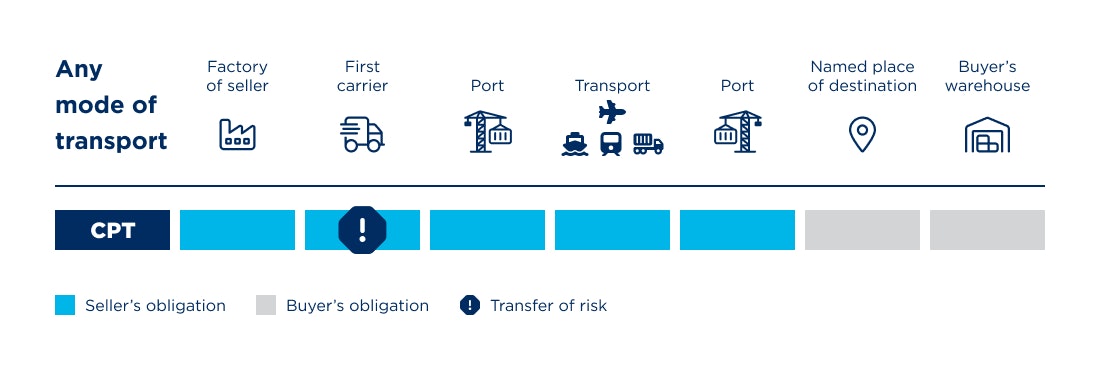
CPT Delivery: Precisely define handover and destination place
Two places are important and should be precisely defined: the place of CPT delivery and the place of destination. In the absence of more precise specifications as well as customary practices, the seller has the right to choose the exact place of delivery at their own discretion. There may be a risk that the place used may pose risks to the goods (e.g. damage or loss).
Since the CPT risk transfer takes place at the place of delivery when the goods are handed over to the first carrier, the exact specification of this place is essential to avoid disputes in the event of damage. The dispute as to whether handling costs at the terminal can be charged to the buyer is also averted if the precisely determined place of delivery is clearly upstream in the CPT supply chain.
Cost allocation for CPT Incoterms 2020
The costs of unloading at the place of destination shall be borne by the seller, unless otherwise agreed. Furthermore, the seller is responsible for CPT export handling, but not for CPT import or even transit via third countries. The buyer takes care of the customs formalities and pays the import duty. However, the seller must assist the buyer, if the buyer requests it, with the relevant documents or information, should these be necessary for the import.
In order for the buyer to be able to take out transport insurance, the seller is obliged to provide the correspondingly necessary information for this with regard to the freight.
Important: If damage occurs due to improper packaging or other actions or omissions on the part of the seller, the seller is liable for the damage. They are also liable for hidden defects, for example, not adhering to the shelf-life of the goods.
FAQ - Incoterm CPT
Can there be different carriers using CPT logistics?
The seller instructs the carrier to organise the transport to the place of destination. For this, the seller receive a continuous consignment note. The carrier, in turn, may commission other carriers for partial sections on their own account, who enter into the contract of carriage originally concluded.
Who bears the costs with CPT?
The seller organises and pays for the transport of the goods for CPT export to a named destination. He also pays for customs formalities for transport abroad (but not for any transit countries!). In other words: As of export clearance, the seller is no longer responsible for foreign trade and customs requirements. The buyer pays for the transport from the moment of handover at the destination, including customs clearance. This also includes unloading costs, and in the case of sea transport, terminal handling charges, service charges for LCL, quay charges, etc., if applicable.
What is important with CPT in terms of packaging?
The seller bears the costs of packaging for the Incoterm CPT. Any quality checks that may be required (weighing, measuring, etc.) also fall under CPT A8, which regulates the obligations for testing, packaging and labelling. The seller must use packaging suitable for transport: suitable for the intended means of transport, protected against damage and loss. The protection of the carrier also plays an important role.
Especially in the case of sensitive goods, it is advisable for the buyer to make precise specifications with regard to the packaging. This must be done before the contract is concluded so that the seller can include any additional costs in his price calculation. If it is not foreseeable in advance whether special packaging arrangements are required, these can be separated out (e.g. as an addition to the Incoterm CPT "plus packaging costs"). Furthermore, it requires safety instructions such as "Caution glass" or the marking of dangerous goods.
CPT export and CPT import: What has to be considered?
The seller is responsible for all export formalities in order to realise a "successful export clearance". If, unexpectedly, the export is permanently prohibited by the authorities, the buyer can withdraw from the purchase contract. However, the buyer cannot claim damages if the impediment to export was beyond their influence and knowledge. The seller takes care of the goods inspections ordered by the authorities and carried out by third parties ("pre-shipment inspections").
The seller may also be required to obtain a security clearance. This is especially true for shipments to the United States. Since the terrorist attacks in the USA in September 2001, there have been significantly increased requirements for supply chain security.
The buyer - responsible for all aspects of the CPT import and, if applicable, transit of goods - requires a range of information on the goods as well as associated documents such as certificates of origin. This depends on the respective destination and the necessary customs regulations. The seller must provide the required data and documents at the buyer's request and at the buyer's expense.
What are the notification requirements for CPT?
The seller must notify the buyer as soon as the delivery has been handed over to the first carrier. This will enable the buyer to insure the cargo and prepare for its receipt at destination. The information must be given in a reasonably prompt manner to allow sufficient time for the necessary arrangements to be made (e.g. preparation of the arrival and unloading place at the expected delivery date). The buyer, in turn, must communicate the desired time and period of shipment as well as the intended destination or unloading place in good time so that the seller is able to follow the specifications.
What are the alternatives to CPT?
If transport damage is a common occurance, it may be desirable for the buyer to better cushion this risk. If using Incoterms DAP (Delievered at Place), the seller also bears the transport risk up to the place of destination. If the buyer feels that the transport damage is due to the seller's choice of carrier, they can, for example, choose the carrier themselveswhen using Incoterm FCA, but they then must also bear the costs of the transport. These costs can be recovered elsewhere in the purchase contract.
Should the buyer take out insurance with CPT for the transport to the destination?
Since the seller organises the transport to the destination, but no longer bears the risk after handover to the first carrier, it makes sense for the buyer to take out insurance. Normally, the seller is responsible for the risks of the transport until handover, but it is often more sensible for both parties to choose continuous insurance cover with corresponding sharing of the costs. If two separate contracts are concluded, there is a risk that disputes will arise as to which insurance company is responsible in each individual case. This can be exacerbated if the place of transfer has not been determined precisely.
What role do delivery and transport documents play in CPT shipping?
In the case of Carriage Paid To (CPT Incoterms 2020), the seller is responsible for preparing suitable delivery and transport documents at their own expense. They must hand over these documents to the buyer or make them available (there is therefore no mandatory obligation to actively hand over specific documents). The transport document identifies the contractual goods and is dated within the period of the shipment. It is important to note that the buyer can use the document to demand the handover of the goods or to resell the goods during transport. The buyer is also obliged to accept a properly drawn up transport document.