Why reduce emissions from shipping?
While maritime transport is vital to the EU economy and is one of the most energy-efficient modes of transportation, it also contributes significantly to greenhouse gas emissions. In 2018, global shipping emissions reached 1,076 million tonnes of CO2, accounting for approximately 2.9% of total human-caused emissions.
Projections suggest that these emissions could rise by up to 130% compared to 2008 levels by 2050. If shipping emissions increase as anticipated, it will jeopardise the goals of the Paris Agreement, which aims to limit global warming to well below 2°C and strive for a cap of 1.5°C.
Within the EU, maritime transport contributed to 3 to 4% of total CO2 emissions, amounting to over 124 million tonnes in 2021.
To effectively reduce greenhouse gas emissions from international shipping, strong global measures are needed. In July 2023, the International Maritime Organisation (IMO) took a significant step by committing to new targets for GHG emissions reductions and planning to develop a set of measures by 2025 to meet these targets. The EU's efforts to ensure maritime transport contributes to achieving climate neutrality in Europe by 2050 are crucial for driving the necessary reductions.
A brief on EU Emissions Trading System (EU ETS)
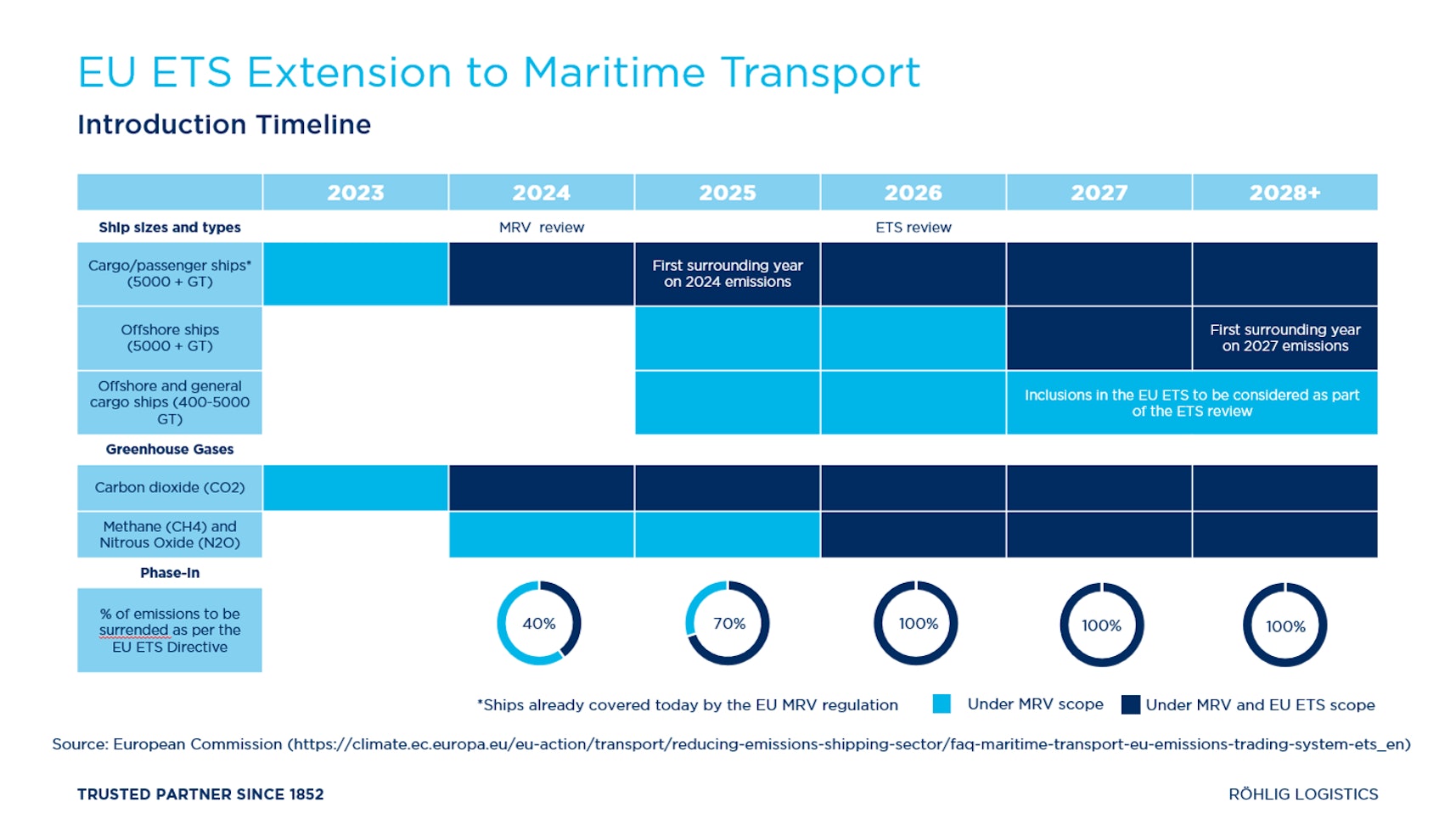
From 1 January 2024, the EU ETS had extended to cover CO2 emissions from all large ships (of 5000 gross tonnage and above) entering EU ports, regardless of the flag they fly.
The EU ETS applies in all EU Member States, the European Free Trade Association countries (Iceland, Liechtenstein and Norway) as well as Northern Ireland for electricity generation (under the Protocol of Ireland and Northern Ireland).
It works on a system of allowances - an allowance is a permit to emit one ton of CO2. Each year, companies across several key sectors must surrender allowances equivalent to their CO2 emissions. Allowances can be bought from EU countries and auctioned and traded afterwards. The number of allowances available across industries is capped and this cap is reduced each year.
To ensure a smooth transition, shipping companies only have to surrender allowances for a portion of their emissions during an initial phase-in period:
2025: for 40% of their emissions reported in 2024;
2026: for 70% of their emissions reported in 2025;
2027 onwards: for 100% of their reported emissions.